



Description
The power of information in your hands
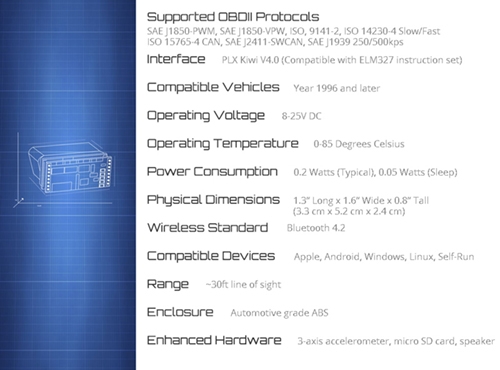
Kiwi 4 is a plug and play automotive tool that connects to the onboard diagnostic port (OBDII / CAN), retrieves information from your car's computer, and wirelessly transmits to your smart phone, tablet, smart watch, or PC. Two modes of operation are available on the Kiwi 4:
Smartphone mode behaves like the Kiwi 1/2/3 where a persistent connection with the smart device must be present. This mode enables real-time data to pass to and from the device enabling powerful OBDII apps like Kiwi OBD and other compatible 3rd party apps to be used.
Self-Run mode does not require a smart device to be present. Kiwi 4 can be configured to monitor up to 16 OBDII parameters so that data is automatically logged in CSV format with corresponding date/time stamps to micro SD card for download and analysis to any PC spreadsheet software.

Maximum Performance
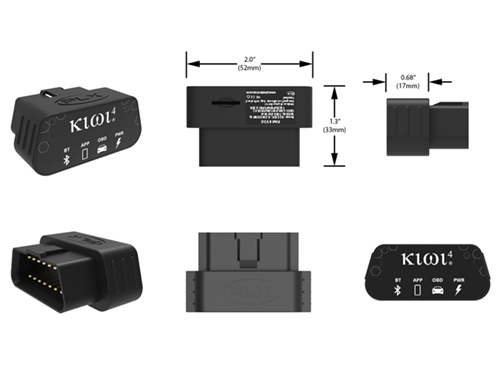
Engineered to outperform all other OBDII devices. Kiwi 4 takes innovation to the next level with 3 powerful new features while retaining the same exterior dimension at only 0.68" thin and the 100% backwards compatibility of the Kiwi 3.
Compatible with 1996 and later vehicles, simply plug Kiwi 4 in and download the Kiwi OBD app to configure your device to enable new features like audible warnings/alerts, data logging, lat/long acceleration without having to rely on permenantly affixing your smart device onto a ridgid surface.

Engine Diagnosis and Monitoring

Depending on the app and the vehicle's make and model Kiwi 4 can display:
| Air flow (MAF) | Air intake temperature | Ambient air temperature | Barometric pressure | Catalytic converter temp |
| Coolant temperature | ECU voltage | Engine load | Engine timing | Evaporative purge |
| Fuel level | Fuel pressure | Intake pressure (MAP) | Long term fuel trims | OBD type |
| Oxygen sensor voltages | RPM | Short term fuel trims | Throttle position | Vehicle speed |
| Distance traveled since code cleared | Distance traveled with malfunction indicator | And more ... |
Cross platform Compatible
Kiwi 4 is compatible with iOS, Android, and Windows Mobile. Kiwi 4 allows for app developers to freely deploy without restrictions like the Apple Made for iPod (MFI) program. As a result, Kiwi 4 is a simple and straight forward making it highly developer friendly.
To ensure a superior user experience PLX partnered with the world's most popular OBD app developers. Kiwi 4 is compatible with the best apps for diagnostics, performance, data logging, fuel efficiency, driving behavior, track, gauges and more!
* DashCommand NOT Recommended for Android 7.x (Nougat) and later

Vehicle compatibility
*All cars and light trucks built and sold in the United States after January 1, 1996 were required to be OBD II equipped.

Kiwi Comparison | Kiwi2+ (for Android) | Kiwi3 (for Apple) | Kiwi4 |
| Compatible Devices | Android | Android, Apple iOS, Windows, Linux | Android, Apple iOS, Windows, Linux |
| Wireless Standard | Bluetooth 2.1 | Bluetooth 4.1 | Bluetooth 4.2 |
| Power Consumption | 1.24 Watts(Active) 0.1 Watts (Sleep) | 0.2 Watts(Active) 0.05 Watts(Sleep) | 0.2 Watts(Active) 0.03 Watts(Sleep) |
| Physical Dimensions | 2.0''x2.0''x0.9" | 1.3"x2.0"x0.9" | 1.3"x2.0"x0.9" |
| Profile Height (When plugged in) | 1.4" | 0.7" | 0.7" |
| CompatibleVehicles | US Vehicles 1996 or newer | US Vehicles 1996 or newer | US Vehicles 1996 or newer |
| Connection Speed | 2x the closest competitor | 4x the closest competitor | 8x the closest competitor |
| Supports all standard Protocols |  | | |
| Supports Single Wire (GMLAN) | | | |
| Check reset engine codes | | | |
| Data log engine parameters | | | |
| Fuel efficiency/driving behavior |  | | |
| Sleep Mode | | | |
| Gold plated OBD connector | | | |
| Upgradable Firmware | - |  | |
| Instant Connect when car starts | - | | |
| Ultra low power | - | | |
| Ultra low profile | - | | |
| Self-run mode | - | - | |
| Integrated Micro-SD Card(Data-logging/Download) | - | - | |
| Built-in Speaker(Audible Warnings/Alerts) | - | - | |
| Integrated High Performance Accelerometer | - | - | |
| Smartphone Configurability | - | - | |
Is your vehicle OBD II compliant?
All cars and light trucks built and sold in the United States after January 1, 1996 were required to be OBD II equipped. In general, this means all 1996 model year cars and light trucks are compliant, even if built in late 1995.
All gasoline vehicles manufactured in Europe were required to be OBD II compliant after January 1, 2001. Diesel vehicles were not required to be OBD II compliant until January 1, 2004.
All vehicles manufactured in Australia and New Zealand were required to be OBD II compliant after January 1, 2006. Some vehicles manufactured before this date are OBD II compliant, but this varies greatly between manufacturers and models.
Two factors will show if your vehicle is OBD II compliant:
- There will be an OBD II connector, and
- There will be a note on a sticker or nameplate under the hood stating "OBD II compliant" or "OBD II Certified".
Where is the connector located?
The connector must be located within three feet of the driver's seat and must not require any tools to be revealed. Most are located under the steering column. If your OBD II port is not there, look under the dash and behind ashtrays.
OBD II Protocols
Auto manufacturers had some leeway in the communications protocol they used to transmit parameters or PIDs, which are required by law to be uniform, to scanners. There are currently five different OBD II communications protocols in use: KWP, PWM, VPW, ISO 9141, and CAN.
What Communications Protocol does my vehicle use?
As a rule of thumb, GM cars and light trucks use SAE J1850 VPW (Variable Pulse Width Modulation). Chrysler products and all European and most Asian imports use ISO 9141 circuitry. Fords use SAE J1850 PWM (Pulse Width Modulation) communication patterns.
There are some variations among captive imports such as the Cadillac Catera, a German Opel derivative, which uses the European ISO 9141 protocol.
On 1996 and later vehicles, you can tell which protocol is used by examining the OBD II connector:
J1850 VPW - The connector should have locations 2, 4, 5, and 16 populated, but not 10 populated.
ISO 9141-2 - The connector should have locations 4, 5, 7, 15, and 16 populated.
J1850 PWM - The connector should have locations 2, 4, 5, 10, and 16 populated.
CAN Bus - The connector should have locations 4, 5, 6, 14, and 16 populated.
ISO 14230 KWP - The connector should have locations 4, 5, 7, 15, 16 populated.
If your vehicle has this style connector, but does not have these pins populated, you probably have a pre-OBDII vehicle. To add some confusion, even having the connector with the contacts shown above is not a guarantee of OBD II compliance. This style connector has been seen on some pre-1996 vehicles which were not OBD II compliant. Most vehicle manufacturers have switched over to CAN bus protocols since 2006.